
Alison Kidd
February 2026
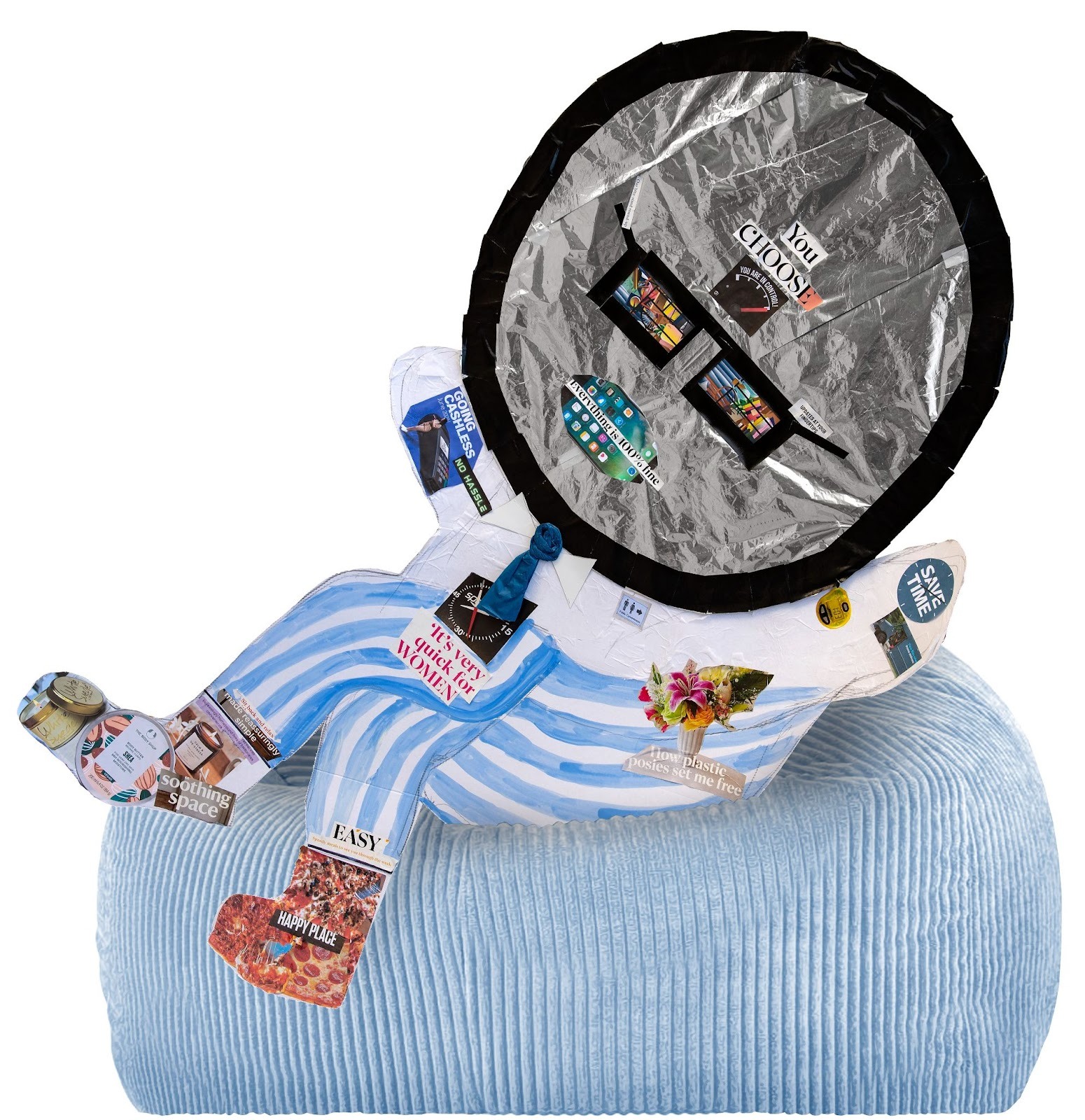
god of Convenience
When, as Larks & Ravens, we are making any of our ‘cardboard gods of our time’, we rarely have much idea at the outset of what any of them will look like. They emerge, almost magically, through the making process …from initially cutting out the cardboard to collaging with images and quotes which happen to jump out at you. So, Convenience materialised as a god who lives a recumbent, relaxed existence with everything available to him at the simple touch of a button the size of his head.
What we didn’t realise until later, when we needed to transport him, was how incredibly inconvenient he actually is compared to any of our other gods. First off, he couldn’t support himself on any flat surface so required the addition of a (now integral) bean bag on which he could permanently lounge in comfort. We then discovered he didn’t fit in the car as conveniently as our other, taller, independently upstanding gods. Nor did he fit into our handy, zip up “god bags” which we’ve introduced for when it’s necessary to transport the gods any distance in the rain.
Interacting with Convenience-the-god has made us realise how much Inconvenience is created (often invisible to us happy button pushers) by our love of the many convenient options on offer today… from shopping to entertainment to money to food… and even to keeping in touch with friends and family. A lot happens behind each button press for the ‘convenience’ value to be delivered.
A recent article from Báyò Akomolafe on the insidious power of switches in our modern lives gave me a greater insight into this…
“Perhaps the most consequential invention of modern power is the switch, toggling between “on” and “off”. With this simple device, the industrial world forged a myth of power that preached convenient utility while ensnaring the newly fabricated user in an algorithm whose hidden codicil was that control was an arrangement of settlement that could never guarantee interesting outcomes even when everything worked as planned.
We still think in terms of switches today. We trust we can simply or, with difficulty, pull the switch in the direction we choose. We trust we are the ones that issue the prompt, the stoic command. We trust we are the users.
But the switch – that poker-faced servant of the gilded user – has a hidden life. At the moment you suppose it is merely responding to your sceptred whim, it is also rearranging your body, training your hand, rehearsing a choreography of expectation in your body. The switch installs a rhythm: on versus off, presence versus absence, signal versus silence, participation versus indifference, left versus right. The switch teaches us to believe complexity can be whipped into compliance, that light waits obedient behind the wall, that power is a matter of access rather than entanglement.
But “behind” the switch, obscured by its comely user-friendliness, is a swarm of grids, the miners, burning forests, server farms whistling in Kenya, cobalt dust in Congolese lungs, and the gravity of power in the attentional. The switch stages power as immediate while hiding the planetary metabolism that makes immediacy possible.
And perhaps most consequentially, the switch persuades us that we are the ones who initiate. We are the ones we’ve been waiting for. We are the Arthurs with teenage hands clasped around the Excaliburs of our time. It is us that begins. It is us to make it work.
But what if the switch is also pulling us, making us? What if each toggle is not an act of control but a participation in an ecology that has already configured our gesture? What if the user is an afterthought, a convenient fiction masking a choreography already underway?
The switch has a hidden life because it is not binary at all. There are worlds curdling in the thick middle between on and off. Beneath the neat click lies a turbulence of gradients, thresholds, probabilities, and negotiations.
The switch does not merely conceal gradients; it conditions us to distrust them. It teaches impatience with ambiguity, with liminality. It makes the middle feel like malfunction. If the light flickers, we call it broken. If the voter prevaricates, he is diagnosed with that most ignominious of all political pathologies: the distinction of being an undecided voter. If the answer hesitates, we call it an error. If love wavers, we call it failure.
The switch trains us to expect decisiveness from worlds that are, by nature, fermenting.
It renders duration suspect. It makes process intolerable. It collapses becoming into outcome. And so we begin to moralize like switches: faithful or unfaithful. Committed or scattered. True or false. On or off.
The switch is the industrialization of moral imagination. Settlement’s taut nipple.
The binary the switch serves is a veneer stretched over an ocean of indeterminacy. And modern power, I daresay, depends on that veneer.”

 The Larks and Ravens